

Federally Funded NeMo.bil Project Successfully Concludes
The partners involved have drawn a highly positive conclusion following the successful completion of the “NeMo.bil” project, which was initiated by “Neue Mobilität Paderborn e. V. (NeMo)”. Funded by the “German Federal Ministry for Economic Affairs and Energy” with approximately €18 million, the project developed and prototyped an innovative mobility system for on-demand passenger and freight transportation. The closing event, held at the “Zukunftsquartier” (Future Appartment) in Paderborn, brought together senior representatives from the German federal government, the ministry, and the project consortium.
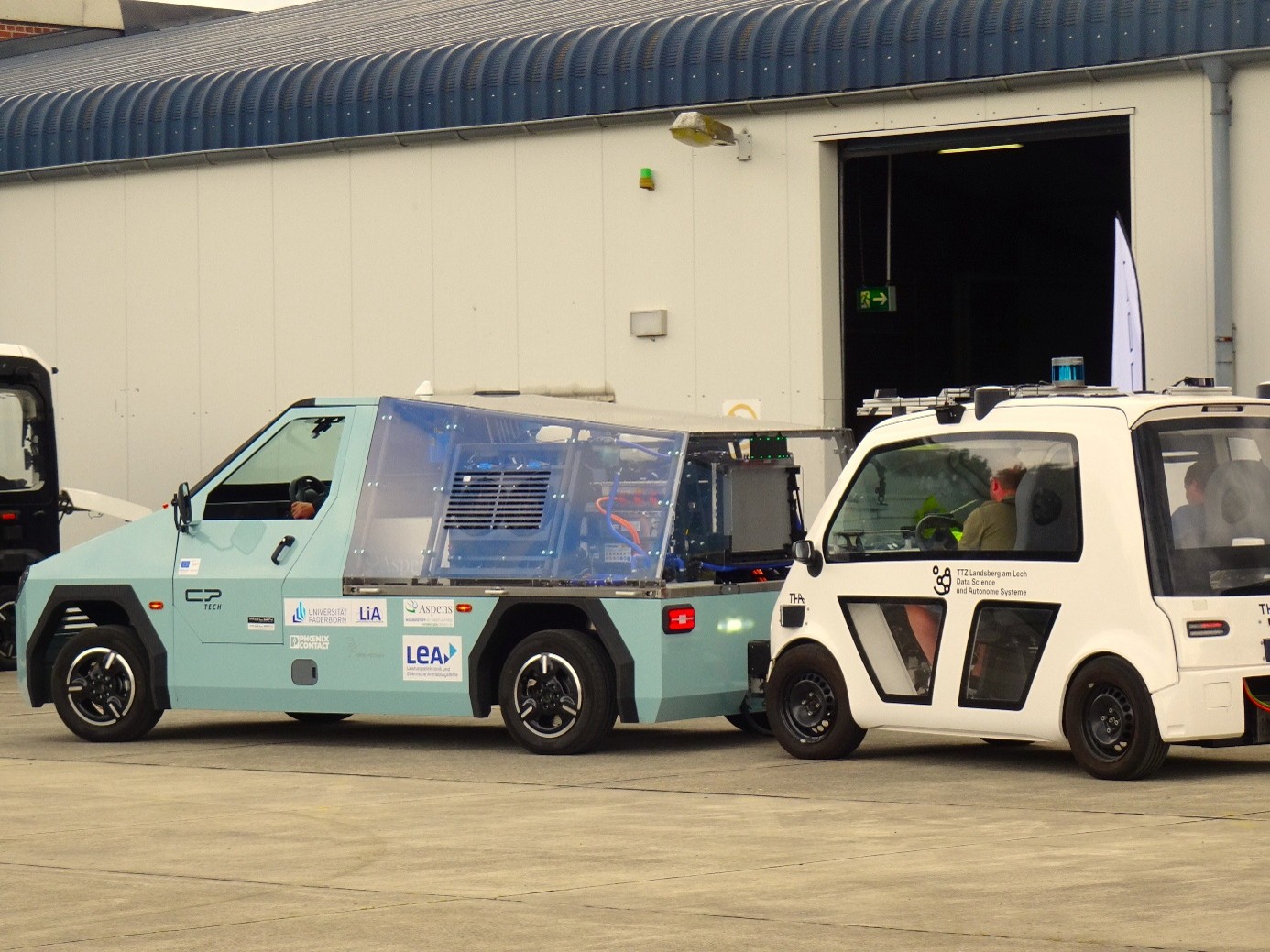
NeMo.bil pursued an innovative mobility concept based on two coordinated vehicle types. Swarms of smaller autonomous vehicles (Cabs) provide first- and last-mile transportation. For longer distances, these vehicles automatically form a convoy led by a larger vehicle (Pro). This concept offers an efficient and resource-saving approach to public mobility, particularly in rural regions, while maintaining the flexibility of individual transportation.
At the final event in Paderborn, guests experienced the project’s results in their entirety for the first time. Representatives from government, industry, academia, and public administration gained insights into the newly developed vehicles, digital applications, and technical systems. Through technical exhibitions, panel discussions, and live driving demonstrations, participants explored how the various components interact to create an integrated mobility ecosystem and the opportunities this technology offers for the future of transportation.
“The NeMo.bil project provided an excellent opportunity to demonstrate the performance and flexibility of our hydrogen fuel cell system under real-world operating conditions. Starting from our 800-volt system, we successfully adapted the technology for the 400-volt platform of the Pro vehicle. In particular, the successful integration of all components into a safe and fully functional overall system demonstrates that our technology can be flexibly adapted to different voltage levels while meeting the requirements of complex vehicle architectures,” said Simon Pauli, Project Manager at Aspens GmbH.
The knowledge gained throughout the project also establishes an important foundation for future applications.
“For us, hydrogen is a key building block of a technology-neutral and climate-friendly mobility future. Through the NeMo.bil project, we demonstrated how long driving ranges, short refueling times, and flexible energy supply can be efficiently combined with electric propulsion. We will use the insights gained to further develop applications in heavy-duty commercial vehicles as well as mobile energy systems,” emphasized Lin Bai, Managing Director of Aspens GmbH.
Although the NeMo.bil project has officially concluded, “NeMo e.V.” will continue advancing the technologies developed during the initiative. The lightweight vehicles designed for first- and last-mile transportation provide a strong foundation for future swarm mobility concepts, with particular emphasis on further technological development and industrialization. The project prototypes will be deployed, tested, and continuously refined in follow-up initiatives.
The “Pro” towing vehicle also offers significant potential beyond its original purpose. In addition to further research into convoy operations, future work will focus on its capabilities as a “mobile charging station” for a wide range of applications. The coupling system developed within the project not only enables the automated formation of vehicle convoys but also opens new possibilities for the automated charging of autonomous vehicles at decentralized charging stations.
Furthermore, the project’s digital ecosystem will continue to generate long-term value. Many of the software components developed according to “open-source principles” have been made accessible to the wider engineering and developer community. This enables the project’s findings to be incorporated into future innovations, contributing to the continued advancement of connected and autonomous mobility technologies.
About the NeMo.bil Project
The NeMo.bil project brought together a broad consortium of partners from industry and academia, including: Aspens GmbH, AVANCO Composites GmbH, CADFEM Germany GmbH, CP Tech GmbH, German Aerospace Center (DLR), dSPACE Group SE & Co. KG, FIWARE Foundation e.V., HOLON GmbH, INYO Mobility GmbH, LIA GmbH, Neue Mobilität Paderborn e.V., PHOENIX CONTACT E-Mobility GmbH, Poppe + Potthoff GmbH, Reisewitz GmbH & Co. KG, Augsburg University of Applied Sciences, Ostwestfalen-Lippe University of Applied Sciences and Arts, TU Dortmund University, Paderborn University, and the WZB Berlin Social Science Center.
For more information, please visit: www.nemo-bil.de